
Three Reasons Why Farmers Markets Are the More Sustainable Choice

Plus: 5 tips on shopping as low waste as possible
As we welcome longer days, warmer weather, and more time outdoors, schedules tend to fill up quickly. However, it’s worth saving time each week for the Yarmouth Farmers Market which runs every Thursday from 3–6pm, May through October on the Memorial Green in front of Town Hall. It’s a space for community gathering and offers an opportunity to make more sustainable choices.

I had the pleasure of attending the first farmers market of the season this year, where I spoke with some lovely vendors and community members. This post explores why the farmers markets can be a more sustainable choice for sourcing fresh food (and includes a few testimonials from the people I met).
Reimagining Meals with Each Season
I have fallen into a routine that suits me quite well. Every Sunday, I set aside time to reset my house and cook a big batch of whatever my chosen dinner will be for the week. As someone who can experience decision fatigue, choosing what meal I am preparing can be daunting. My usual solution is to find out what produce or organic meat is on sale and build my meal around that. I’ll also often look at the forecasted weather for the week (there were many great soup weeks this past winter).

Produce sales at the grocery store are usually correlated to the current growing season. Reliably, every February, I know that citrus will go on sale. Winter is peak citrus season in the Northern Hemisphere, which means there is more supply and it costs less to transport that fruit to stores because it is more “local.” While I would not consider Florida, California, or Arizona local to Maine, they are certainly closer than Australia, Chile, or Brazil - where citrus is often transported from in the summertime.
Distance doesn’t just affect cost - it also affects flavor. Have you ever noticed the difference in taste between a tomato fresh off the vine or from a farmers market versus one bought at the grocery store in March? The flavors aren’t even comparable and, in my experience, this holds true for most produce.
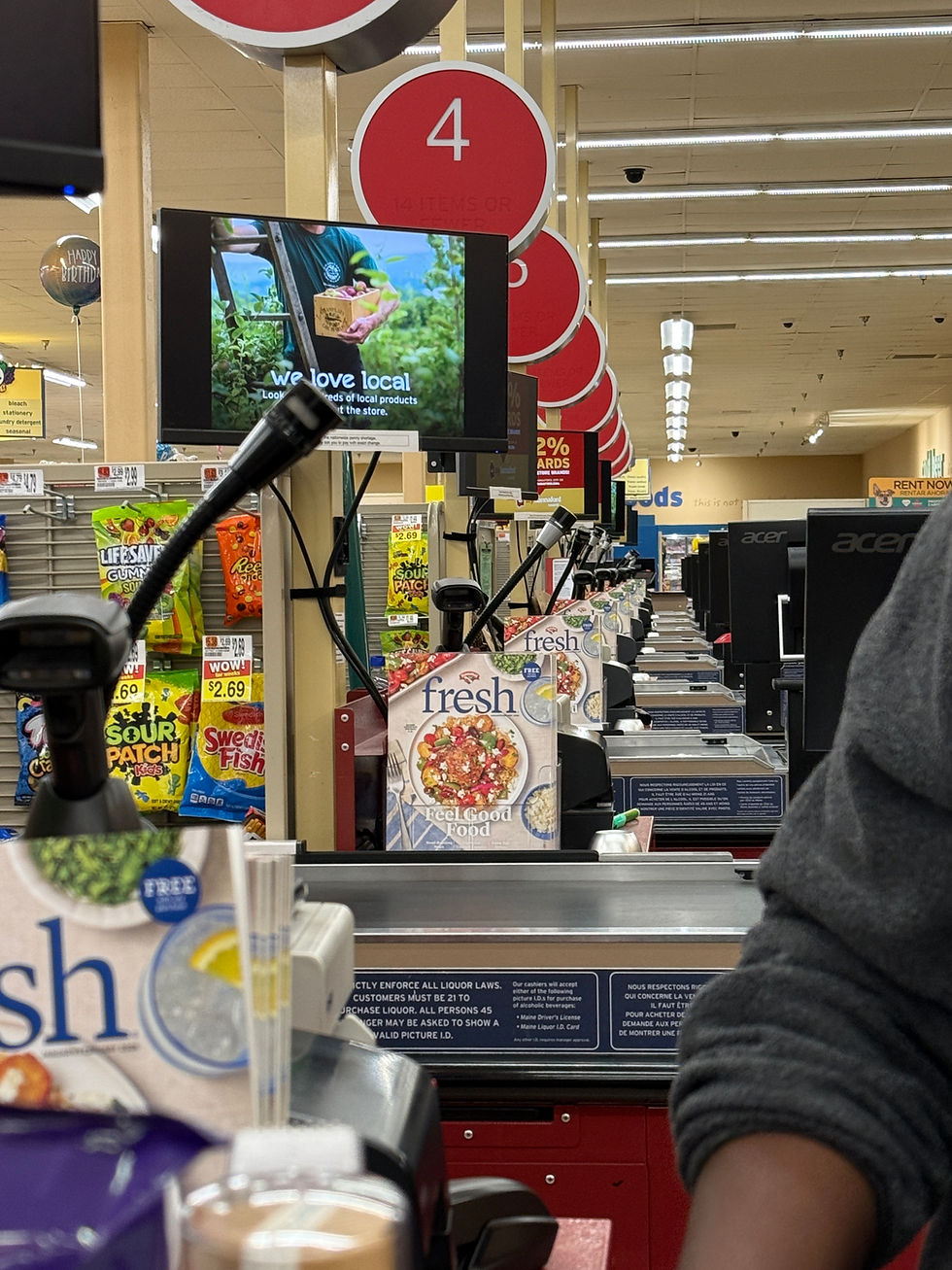
When fruits and vegetables are grown with the expectation that they will travel hundreds or thousands of miles, they are often harvested before they are ripe. The idea is that they will ripen during transport, or they are treated with ripening agents to ensure they are ready by the time they reach the shelf.
If you are curious to learn more about how farmers may regulate the ripening process, I would recommend reading this article.
Food transportation is also directly related to how our food is produced globally. Large agricultural corporations operating internationally often rely on labor practices and chemical use that would not be permitted in the United States. Certain pesticides that are banned here can still be used on crops grown abroad and then imported, as long as the residue on the final product falls below regulated thresholds.
Buying locally grown food reduces the need for ripening interventions and can limit our exposure to those chemicals. The reduced transportation distance for in-season produce is also directly correlated with lower greenhouse gas emissions, which is part of why seasonal eating and purchasing produce from local farmers is considered more sustainable.
Next time you pick up an apple or orange at the grocery store, take a look at the sticker. How far did this piece of produce travel for it to end up in your hand?

Local farms also support the local environment. Healthy farms preserve fertile soil, sequester carbon, and reduce chemical runoff into our water sources. They provide habitats for wildlife and contribute to a more resilient local ecosystem.
In addition to being more economical and sustainable, seasonal eating offers an opportunity to live more in alignment with the seasons. Think about the foods we naturally gravitate toward in winter - potatoes, onions, and hearty brassicas. Compare that to the lighter, sweeter, and crunchier foods of summer - leafy greens and fresh fruit. It’s almost like the earth knows what we need.
And maybe that’s the point: by paying attention to what’s growing and when, we can simplify our choices, support a more sustainable food system, and settle a little more comfortably into the rhythm of where we are.

One way to enjoy seasonal produce when it’s not in season is through preserving. Andrew from Hardscrabble Sauce Co. does precisely this through the creation of their hot sauces. Andrew explained that, in addition to growing their peppers locally, they try to source the other ingredients as locally as possible.
This will be Hardscrabble Sauce Co.’s first summer at the Yarmouth Farmers Market, and after seeing the community the market brought together last winter, Andrew shared that he is excited to see what this season will bring. Andrew told me that the Yarmouth Farmers Market brings a “vast array of personalities and products” and is “an outstanding example of what Maine has to bring to the table”.
Shopping seasonally (and locally) can often be more expensive to alternatives, so the Yarmouth Farmer's Market has several avenues to help make the market goods more affordable for everyone, including double value for EBT and $25 market vouchers. Learn more about these programs on the Market website.
Rethinking Waste
I grew up in a town with curbside trash pickup. It was very convenient; I would throw something into the trash, and it disappeared. Out of sight, out of mind. Yarmouth’s waste system works a little differently. In 2019, The Town of Yarmouth adopted a Pay-As-You-Throw (PAYT) system. Fundamentally, PAYT creates a financial incentive to generate less trash. It may take a few more steps to dispose of trash, but these steps help reduce how much waste ends up in landfills.

In addition to collecting household trash, the Yarmouth transfer station also collects single-sort recycling and food waste at no additional cost. If you have recycling that doesn't fit into a single-sort recycling category, the transfer station will also accept these items (like electronics), usually at a fee. Food waste collected in Yarmouth is not made into traditional compost, instead it is sent to Agri-Cycle, where it is processed in a way that creates energy.
While recycling and food waste diversion are great alternatives to tossing something in the trash, not everything can be redirected. That’s where understanding the impact of waste becomes important.
When I was in middle school, we did a unit on waste. My teacher made a point that changed how I think about trash: when we throw something away, we’re not just getting rid of it, we are giving up the chance to ever use that material again. She illustrated this with a sealed plastic water bottle. Once it’s thrown in the trash, that water becomes inaccessible and can’t reenter the water cycle. It remains trapped inside the bottle until the plastic breaks down, which can take hundreds of years.

The same principle applies to food waste. When food is sent to a landfill, it decomposes in low-oxygen conditions, often inside plastic bags. In addition to preventing food waste from re-entering the nutrient cycle, this process produces methane, a powerful greenhouse gas that contributes to climate change. When food waste is composted, it breaks down in an oxygen-rich environment with beneficial microbes, eventually becoming soil.
At facilities like Agri-Cycle, food waste is used to generate methane in a controlled setting. That methane is captured and converted into biofuel. While it still contributes to greenhouse gas emissions, it gives that waste a second purpose.

According to a 2018 study by the United States Environmental Protection Agency, containers and packaging make up about 28% of municipal solid waste. A major reason for this is that much of today’s packaging isn’t easily recyclable - especially plastic film. Plastic materials that can bend or stretch like fabric are typically considered plastic film, and they’re among the most difficult items to recycle.
This includes items like:
Garbage bags
Plastic shopping bags
Plastic shipping envelopes
Bread bags
Snack bags
Bubble wrap
Plastic film is also the type of plastic that has the highest potential to pose health risks through exposure. This was explored in a bit more detail in this blog post.
Unfortunately, the prevalence of single-use plastics today did not happen by accident. In the post–World War II era, the plastics industry sought ways to expand its market. One strategy was to promote a shift away from a culture of reuse and toward one centered on convenience and easy disposal. If products were designed and marketed to be used once and discarded, consumers would need to purchase them again and again.

Although it may seem that I abhor plastic, it’s not entirely a villain. Before plastic packaging, goods were transported in heavier materials like glass, metal, and wood. These required more fuel to transport, increasing greenhouse gas emissions. Plastic has also been essential in the medical field, enabling sterile, affordable equipment that saves lives every day. The predicament isn’t plastic itself, it’s how much we use, and how often we throw it away.
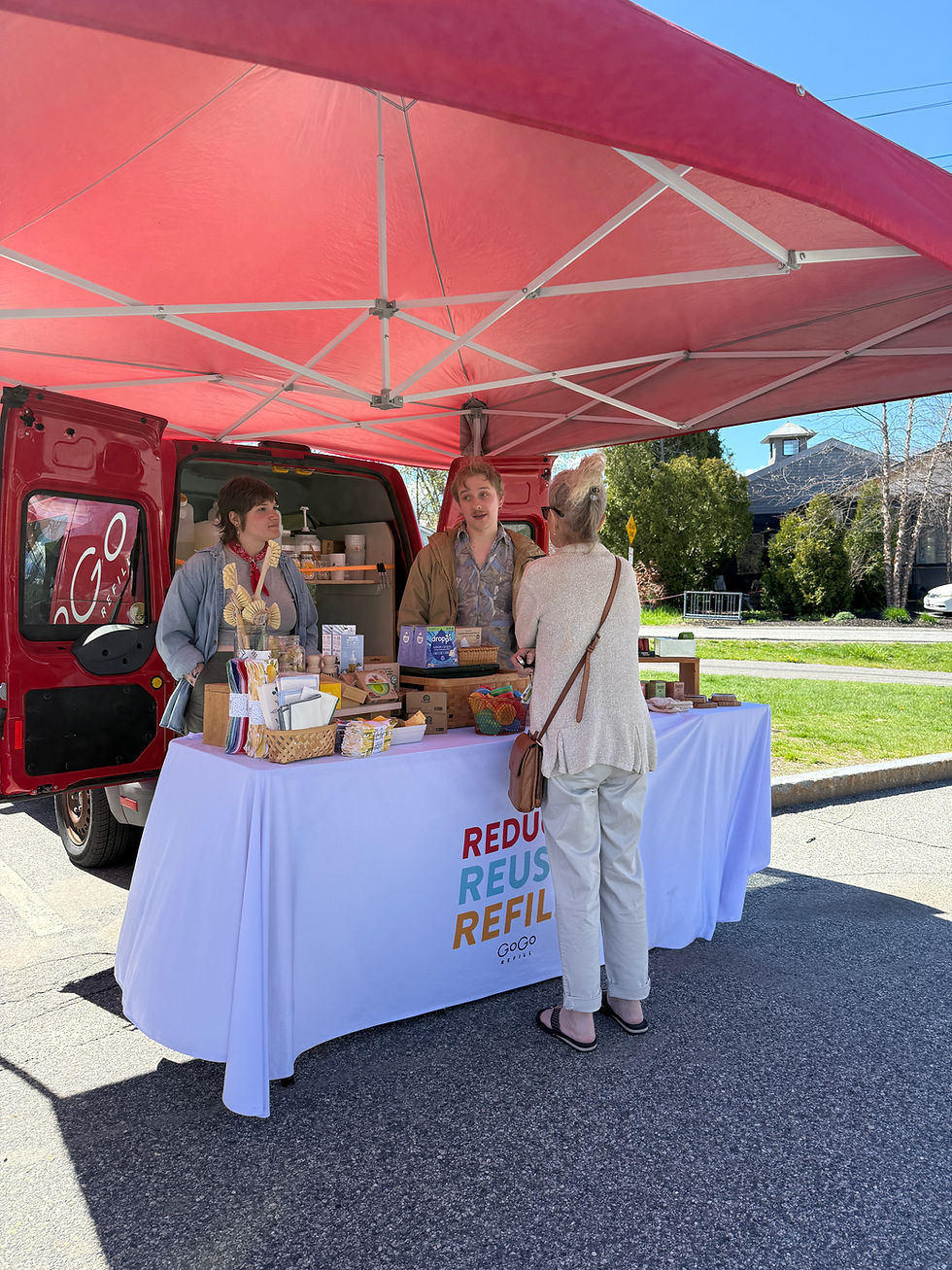
For most people, a completely zero-waste lifestyle isn’t realistic. But small changes can make a meaningful difference. Shopping locally at farmers markets or bulk food stores offers opportunities to select packaging that can be reused, composted, or recycled. Michael from GoGo Refill articulated the advantage of shopping locally perfectly: “In a weird time when you don’t always know where your money is going, buying local keeps the money in the community, and the small businesses you support can then support other local businesses in the area”. It is the perfect kind of feedback loop.
While you’re visiting the Yarmouth Farmers Market, here are five simple ways to reduce waste:
Bring reusable bags and jars
Bring a reusable mug - some vendors, like Everkind Coffee Works, offer discounts
Check out the GoGo Refill booth for low-waste products (and sometimes spare jars)
Ask vendors to use your reusable containers or choose paper when available
Only buy what you need (and support the market the next week!)
Rooted in Community
In Maslow's Hierarchy of Needs, love and belongingness sit at the center. Humans have an emotional need for connection, in all its varying forms.
We have found ourselves amidst a digital age. I am able to connect with my friends in Hawaii and Minneapolis on a regular basis, and from anywhere. We can see what our peers choose to share about their lives online and exchange ideas with others across the globe. But, while it’s easier than ever to connect, it’s harder to truly feel connected. You lose the nuances you get through body language, tonal shifts, and backchanneling.
Having left my undergraduate bubble - where everyone gathers at the student center to socialize, the library to study, and you can almost always spot a familiar face at the bar downtown - I’ve found myself wondering: where do people go after work? Where do people hang out?
A “third space” is an area that is neither home nor work. It’s somewhere you go to exist alongside others, to socialize, to feel part of a community. Traditionally, these spaces include libraries, malls, parks, places of worship, cafes or bars, salons, and recurring community events.

The Yarmouth Farmers Market is a perfect example of a third space in action. It’s a place where people gather, share a meal, dance, catch up, and play. I had the pleasure of talking with a few vendors at Yarmouth’s first market, and the value they all came back to was community.
Janelle at New Spoke Farm shared with me that “farmers markets are a great way to practice sustainability because you are building community and creating connections in person, developing a foundation together.’ She emphasized that the “community element of sustainability is very important and often underrepresented”, a sentiment that I strongly agree with.
In a time where so much of our interaction is filtered through screens, spaces like this feel increasingly important. They give us a place to show up as we are, to run into familiar faces, and build new relationships.

If you made it this far, hopefully I have convinced you to check out the Yarmouth Farmers Markets from 3-6pm every Thursday starting 05/07 through October.
Maybe I’ll see you at one soon.


